Contractions of the uterine muscle play a central role not only during labor but also throughout a woman’s menstrual cycle. In particular, they facilitate the transport of sperm to the ovaries during ovulation and the expulsion of menstrual blood during menstruation. In endometriosis and adenomyosis, uterine contractions are abnormal: they are too forceful, causing menstrual pain and contributing to infertility. They play a central role in the pathogenesis of these conditions by promoting the spread of endometrial fragments into the abdominal cavity. However, the mechanisms governing uterine muscle contraction remain poorly understood: it is not known why contractions are exacerbated in endometriosis and adenomyosis, and there is currently no drug that can specifically relax the uterus. To address these challenges, the Endometriosis Research Foundation has been supporting the HYPERU project since 2023. The project is led by researchers at the Complex Matter and Systems Laboratory (CNRS / Université Paris Cité) in collaboration with Paris Saint Joseph Hospital. In a paper published in the journal *Frontiers in Pharmacology*, the researchers have taken an important first methodological step.
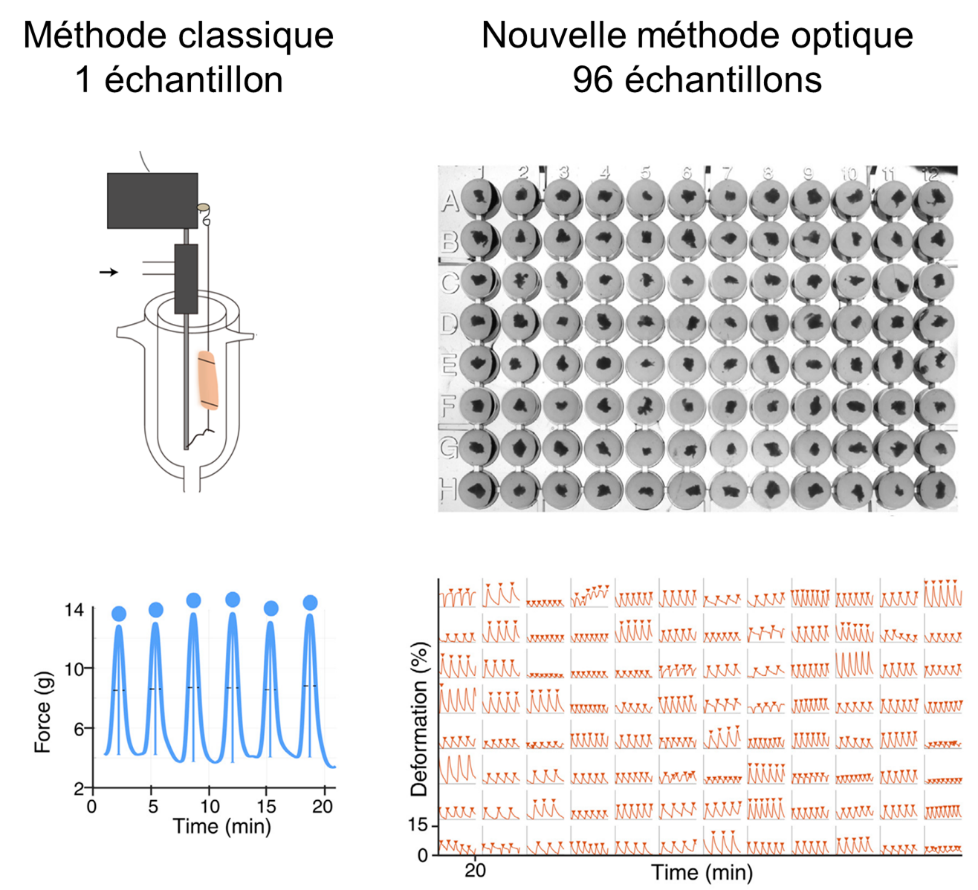
The traditional method for measuring uterine contractions involves attaching a myometrial flap obtained from surgical specimens to a transducer and measuring the periodic force signal. This method is limited by the number of transducers available—between 1 and 4, depending on the device—which makes it difficult to perform pharmacological screening. To overcome this challenge, researchers at the MSC laboratory have developed a method that allows them to test 96 tissue pieces in parallel using the same amount of tissue!
This new method relies on optical—rather than mechanical—measurement of uterine muscle deformations. Using an automatic microtome, the researchers cut a biopsy specimen into millimeter-sized fragments. They placed each fragment in a “96-well” plate and filmed the entire process with a very high-resolution camera. They were able to demonstrate that each fragment exhibited spontaneous contractions at the same frequency as the original tissue sample. They applied 96 different pharmacological conditions to study, in particular, the effects of the hormones estrogen and progesterone. They confirmed that the results obtained were consistent with the standard transducer-based measurement method. The scientists ultimately highlighted the uterine-relaxing effect of several compounds, including benzbromarone, an anti-uricemic agent.
These advances will facilitate the development of molecules that can normalize uterine contractions in cases of severe dysmenorrhea, endometriosis, and adenomyosis, as well as prevent preterm labor, which affects 10% of births and remains the leading cause of infant mortality.
Référence
Huon E, Rayssac J, Lamau M-C, Abo C, Dietrich G, Abrahami Y, Kouby J, Adam J and Chevalier NR (2026) A high-throughput 96-well plate method to measure human uterine contractility. Front. Pharmacol. 17:1953934. doi: 10.3389/fphar.2026.1953934